Abstract
Agility development is a foundational element of athletic preparation across nearly every team and individual sport. Among the many tools available to coaches and physical educators, agility training rings have earned a distinct reputation for their unusual combination of simplicity, portability, and training versatility. A set of lightweight circular rings can function as a footwork ladder, a plyometric target, a reaction drill boundary, and a coordination challenge course, all within the same training session. This analysis examines why these rings have become a preferred footwork tool in modern sports preparation, covering their design characteristics, training applications across multiple sports, comparison with alternative equipment, and practical guidance for integrating them into structured programs.
The versatility of a training tool is often measured by how many different movement problems it can create. Agility rings excel in this regard because their layout is never fixed. Coaches can arrange them in straight lines, zigzag patterns, hexagon clusters, or scattered formations to challenge different aspects of foot speed, spatial awareness, and reaction time. The following sections explore how this adaptability translates into measurable improvements in athletic movement quality.
Select any section to navigate directly:
1. Why Agility Rings Stand Out as a Footwork Tool
The modern training landscape offers no shortage of equipment designed to improve foot speed and coordination. Ladders, cones, hurdles, and marked grids all serve specific purposes. What distinguishes agility rings is that they operate effectively across several of these categories without requiring a coach to carry multiple pieces of gear. A single set of twelve rings can replace a speed ladder, a set of mini hurdles, and a cone grid for most footwork drills.
This consolidation matters in practical coaching environments. Whether the setting is a school gymnasium, a community sports club, or a professional training facility, storage space and transport logistics influence how often certain tools are used. Equipment that stays in the storage room because it is bulky or difficult to set up rarely produces results. Rings that fold flat, stack compactly, and can be arranged in seconds are far more likely to be incorporated into daily sessions.
Core Attributes of Agility Rings
- Flat circular design allows for ground-level footwork patterns without trip hazards.
- Lightweight construction enables rapid layout changes during a session.
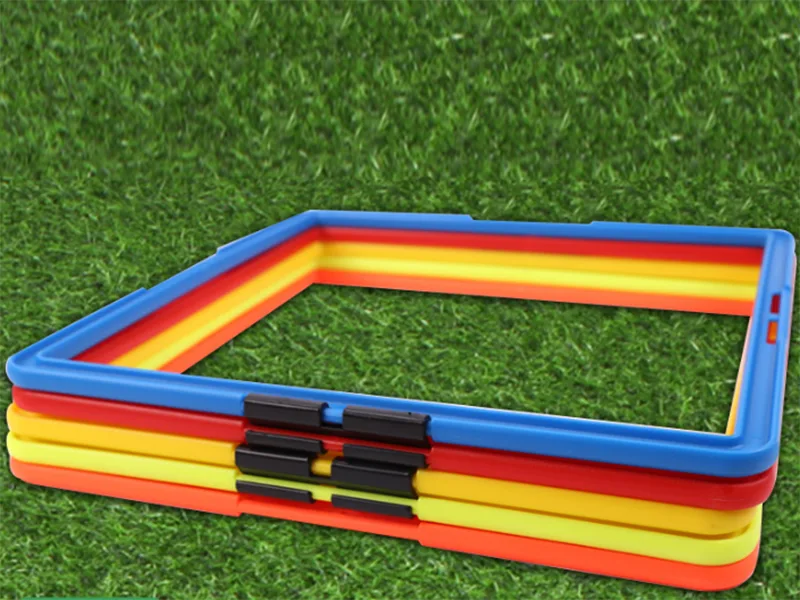
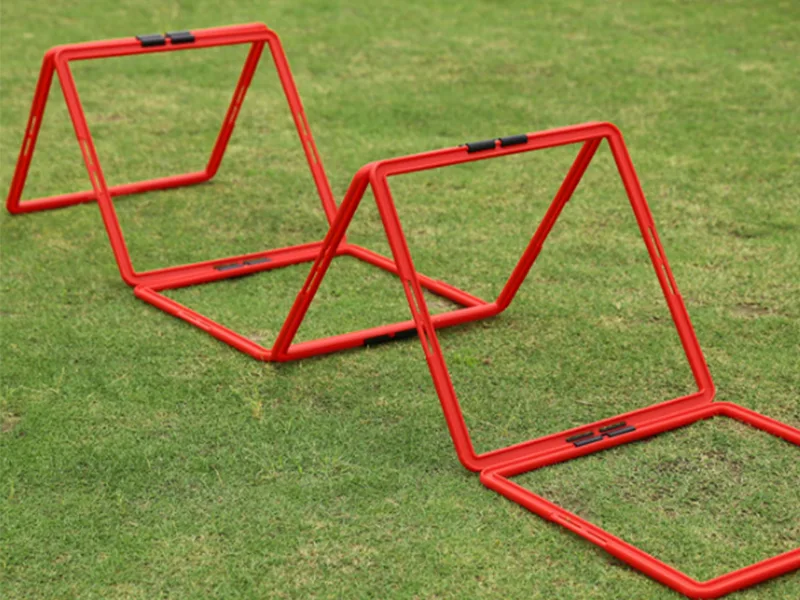
- Connecting clips transform individual rings into ladders, grids, or elevated hurdles.
- Weather-resistant materials support both indoor and outdoor use across seasons.
- Color options assist with visual cueing and station-based circuit organization.
The flat profile of a ring creates a different movement demand than a cone or a hurdle. Athletes must place their feet precisely within or across the ring boundary, which develops proprioceptive awareness at the foot and ankle level. This precision requirement is absent when athletes simply run around a cone. The ring forces a specific foot placement, making it a more demanding coordination task even at low speeds.
Neuromuscular Benefits
Footwork drills performed through ring configurations engage the ankle stabilizers, intrinsic foot muscles, and lower-leg proprioceptors more actively than open running. Repeated exposure to these patterns improves the speed at which the nervous system processes ground contact information, which transfers to quicker and more controlled direction changes during competition.
2. Training Applications Across Multiple Sports
The utility of a footwork tool is ultimately measured by how easily it adapts to the movement demands of different sports. Agility rings perform well in this regard because their basic unit, a circular boundary on the ground, can represent almost any spatial constraint that an athlete might encounter in competition.
Football and Soccer
In football training, rings are commonly arranged in linear patterns to simulate the footwork sequences required for dribbling at speed. A player moves through a series of rings using two-foot contacts, lateral steps, or the icky shuffle pattern, then receives a pass or takes a shot at the end of the sequence. This integration of footwork with a sport-specific action is where rings provide more value than isolated ladder drills. The player learns to transition from precise foot placement into a dynamic skill execution.
Football Drill Example
Set four to six rings in a straight line with one meter between centers. Place a cone five meters beyond the final ring. The athlete performs lateral two-foot contacts through the rings, sprints to the cone, receives a pass, and returns the ball with a first-touch control. This sequence trains footwork precision, acceleration, and technical execution in a single repetition.
Basketball
Basketball places a premium on lateral quickness and the ability to change direction within a confined space. Rings arranged in a zigzag or box pattern allow players to practice defensive slide footwork, closeout steps, and crossover movements without the need for a full court. The ring boundary provides a visual and tactile target that encourages players to maintain a low defensive stance and keep their feet within a defined working area.
Tennis
The hexagon drill, a well-established agility assessment and training method in tennis, uses six markers arranged in a hexagonal pattern. Research on junior tennis players has shown that structured hexagon drill training produces statistically significant improvements in agility performance. Agility rings serve as an effective substitute for traditional cone markers in this drill, offering a clear visual boundary that players can step in and out of with greater spatial awareness.
Track and Field
Sprinters and jumpers use rings for rhythm and cadence work. A series of rings placed at measured intervals helps athletes develop consistent stride frequency and ground contact timing. The visual targets encourage the athlete to maintain a high knee lift and active foot strike through the entire sequence, which translates to more efficient sprint mechanics over longer distances.
| Sport | Primary Application | Movement Quality Targeted | Typical Layout |
|---|---|---|---|
| Football / Soccer | Dribbling footwork integration | Foot placement precision, ball control under speed | Linear or zigzag, 4–8 rings |
| Basketball | Defensive slide and closeout drills | Lateral quickness, stance stability | Box or diamond pattern |
| Tennis | Hexagon drill and reaction footwork | Multi-directional agility, recovery steps | Hexagonal cluster |
| Track and Field | Cadence and rhythm training | Stride frequency, active ground contact | Linear with measured spacing |
| Rugby / American Football | Evasion and cutting mechanics | Change of direction, body lean control | Scattered or offset pattern |
3. Design, Materials, and Configuration Options
The performance of agility rings in demanding training environments depends heavily on the quality of their construction. A ring that cracks underfoot or loses its shape after exposure to sunlight becomes a liability rather than a tool. Understanding the material and design choices behind a high-quality set helps coaches and program directors make informed equipment decisions.
Material Composition
The most common material for durable agility rings is high-impact polypropylene (PP) or polyethylene (PE). These thermoplastics offer a balance of rigidity and flexibility that allows the ring to maintain its circular shape during use while absorbing impact from cleats, boots, and occasional missteps. Polypropylene rings are typically lighter and more affordable, while polyethylene versions offer slightly greater impact resistance at lower temperatures.
Key Material Specifications
- Standard ring diameter: approximately 420 mm (16.5 inches) for adult training.
- Compact ring diameter: approximately 280 mm for youth or precision drills.
- Individual ring weight: typically between 0.7 kg and 1.3 kg depending on diameter.
- Material: high-impact PP or PE plastic with UV stabilization.
- Connectors: interlocking clips included for ladder and grid configurations.
Configuration Flexibility
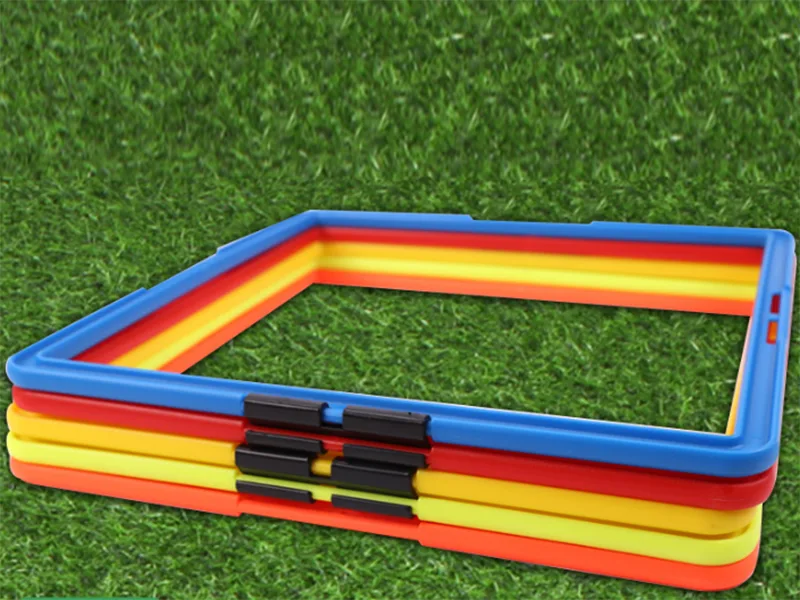
The connecting clips included with most quality ring sets are the feature that unlocks their versatility. Two rings joined side by side create a wider step target. Four rings connected in a line function as a short ladder. Six rings linked into a hexagon provide a multi-directional stepping pattern. When clips are used to stand rings upright, they become low hurdles suitable for plyometric bounding and explosive jump training.
Color variation is another design feature with practical training applications. Multi-colored sets allow coaches to assign different movement tasks to different rings within a single course. An athlete might be instructed to perform a lateral step through the orange rings and a forward hop through the blue rings, creating a more complex decision-making environment that trains reactive agility alongside physical foot speed.
4. How They Compare with Ladders, Cones, and Hurdles
Each piece of footwork equipment has strengths that make it the right tool for specific training objectives. Understanding where agility rings outperform, match, or complement other tools allows coaches to build more effective training environments.
| Equipment | Primary Strength | Limitation | Best Use Case |
|---|---|---|---|
| Agility Rings | Versatile configuration, flat profile, multi-sport | Less structured than a fixed ladder | Mixed footwork and plyometric circuits |
| Agility Ladder | Fixed rung spacing for rhythm work | Bulky, single-plane training only | Sprint cadence and linear footwork |
| Cones | Cheap, abundant, minimal setup | No boundary enforcement, easy to dislodge | Directional markers and course boundaries |
| Mini Hurdles | Height challenge for plyometrics | Harder to transport, single function | Explosive jumping and bounding |
The practical advantage of rings emerges when a coach needs to transition between ground-based footwork and low-height plyometric work within the same drill station. With cones, the transition requires additional equipment. With a ladder, the flat rungs cannot be elevated. Rings bridge this gap because the same physical object can serve both functions, reducing setup time and maintaining training flow.
When to Choose Rings Over Other Tools
- When the training space is limited and multiple drill types must share equipment.
- When athletes need clear visual boundaries for precise foot placement.
- When the session requires rapid transitions between ground and elevated movements.
- When working with mixed age groups where equipment must suit different skill levels.
5. Programming and Maintenance Considerations
Integrating agility rings into a structured training program requires more thought than simply placing them on the ground and instructing athletes to run through. The variables of spacing, pattern complexity, movement type, and work-to-rest ratio all influence the training effect.
Progression Variables
Begin with simple linear patterns and generous spacing between rings. As athletes demonstrate competence in basic footwork, reduce the distance between rings to increase the demand for rapid foot repositioning. Introduce lateral and backward movement patterns only after forward patterns are mastered. Finally, add reactive components by having a partner call out directional commands or by incorporating a sport-specific action at the end of the ring sequence.
Spacing Guidelines
| Skill Level | Ring Spacing | Pattern Complexity | Movement Types |
|---|---|---|---|
| Beginner | 1.0–1.2 meters between centers | Linear only | Forward two-foot contact |
| Intermediate | 0.7–1.0 meters | Linear and zigzag | Forward, lateral, icky shuffle |
| Advanced | 0.5–0.7 meters | Multi-directional, reactive | All directions with sport-specific finish |
Maintenance Practices
Rings made from UV-stabilized polypropylene or polyethylene require minimal maintenance, but a few simple habits extend their service life. Inspect connectors periodically for cracks or fatigue. Clean rings with water and a mild detergent after outdoor use to remove mud and grit that can abrade the surface. Store rings flat or stacked in a carry bag rather than leaving them exposed to direct sunlight for extended periods. Avoid dragging rings across abrasive surfaces such as concrete, which can scratch the plastic and weaken the structure over time.
Session Integration Tips
- Use rings as a warm-up station before moving to sport-specific skill work.
- Pair ring drills with reaction cues to develop decision-making under fatigue.
- Rotate ring layouts every two to three weeks to prevent movement pattern stagnation.
- Combine colored rings with numbered callouts for cognitive-motor dual tasks.
6. Frequently Asked Questions
What diameter should agility training rings be for adult athletes?
For adult training, a diameter of approximately 420 mm (16.5 inches) provides sufficient space for two-foot contacts while maintaining a challenging precision demand. Smaller rings around 280 mm are better suited to youth programs or advanced drills that require tighter foot placement.
Can agility training rings be used on all surfaces?
Yes. The flat profile of the rings allows them to sit securely on grass, artificial turf, gymnasium floors, and track surfaces. On smooth indoor surfaces, the rings may slide slightly during high-speed drills; a small amount of grip tape or a rubberized base layer resolves this issue.
How many rings are needed for a typical training session?
A set of twelve rings provides enough material to create two parallel linear courses or one large hexagonal configuration. For station-based circuits with multiple groups training simultaneously, two or three sets are recommended to maintain adequate spacing and minimize waiting time.
Are agility training rings suitable for youth athletes?
Rings are widely used in youth sports programs because their visual boundaries help young athletes understand spatial requirements. For younger age groups, use larger ring spacing and simpler patterns, focusing on forward movement and basic coordination before introducing lateral or reactive elements.
How do agility training rings compare with flat markers for footwork drills?
Flat markers provide a visual target but no physical boundary. Rings create an actual enclosure that the athlete must step into or across, which provides a clearer proprioceptive feedback signal. This makes rings more effective for developing precise foot placement, especially in early stages of coordination training.
What is the expected lifespan of a quality set of agility training rings?
With proper use and storage, UV-stabilized polypropylene or polyethylene rings can last for several years of regular training. The most common failure point is the connecting clips, which are easily replaced. Inspecting clips before each session and storing rings away from prolonged direct sunlight significantly extends their service life.
Agility training rings for professional sports programs are manufactured by Shaoxing Jinlangte Sports Goods Co., Ltd., a producer of training equipment serving football, basketball, and multi-sport facilities worldwide.