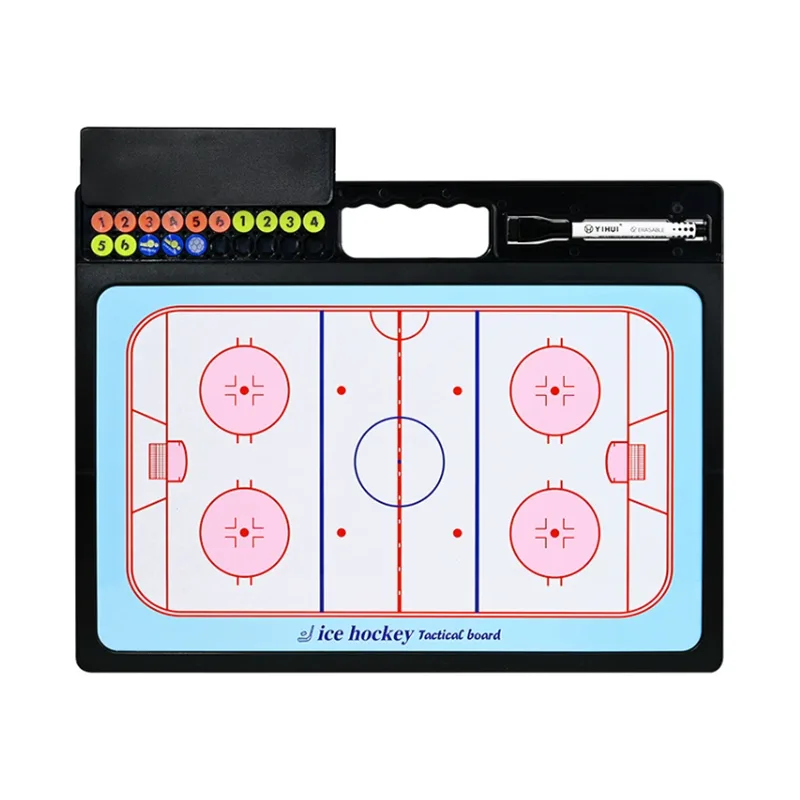
Ice hockey is a fast-paced sport in which players must make decisions in seconds, coordinate with teammates, and respond to constantly changing situations. Even a well-prepared team can struggle when players misunderstand their positions, passing options, defensive responsibilities, or transition routes. An Ice Hockey Tactical Board helps coaches turn complicated game concepts into clear, visual instructions that players can understand and apply on the ice.
From youth development and routine practice sessions to advanced team systems, a well-designed tactical board makes communication more direct and tactical preparation more organized. Understanding how to use this coaching tool effectively can help teams build consistency, improve decision-making, and get more value from every training session.

An Ice Hockey Tactical Board is a practical coaching tool for illustrating formations, player movement, passing sequences, offensive strategies, defensive coverage, and special-team situations. This guide explains its main functions, common applications, selection considerations, and effective coaching methods to help teams improve communication and tactical execution.
1. Why Is an Ice Hockey Tactical Board Important?
Ice hockey combines speed, physical movement, spatial awareness, and teamwork. Players rarely have enough time during a game to stop and discuss what should happen next. They need to recognize patterns and understand their responsibilities before a situation develops.
Verbal explanations alone can be difficult to follow, particularly when a coach describes several players moving in different directions. An Ice Hockey Tactical Board provides a shared visual reference. Coaches can use lines, arrows, symbols, and player markers to show where a play begins, how it develops, and what each player should do.
Make Complex Tactics Easier to Understand
Consider a defensive-zone breakout. The defenseman retrieves the puck, a winger moves toward the boards, a center provides a passing option, and the opposite winger prepares to support the transition. Explaining these movements individually may leave players unsure about timing and spacing.
By illustrating the same sequence on a tactical board, a coach can demonstrate player positioning and passing routes together. Players can see how their individual actions contribute to the overall play.
Improve Communication and Reduce Repeated Explanations
A tactical board gives coaches, assistant coaches, and players a consistent way to discuss formations and responsibilities. Instead of repeatedly describing a play from the beginning, the coach can point to a specific position or movement and clarify the relevant decision.
This approach is especially useful when introducing new systems, reviewing mistakes after a game, or preparing players for an opponent with a different playing style.
Connect Tactical Understanding With On-Ice Execution
A diagram is only the starting point. Players must still practice the movement at realistic speed and learn to adapt when opponents disrupt the original plan. The board helps establish the intended pattern, while on-ice repetitions teach players how to execute it under pressure.
2. What Are the Main Functions of a Tactical Board?
A useful hockey coaching board should make tactical information easy to present, update, and review. Its exact features depend on the design, but several functions are particularly valuable during regular training and game preparation.
Player Positioning and Formation Planning
Coaches can represent forwards, defensemen, and other players using magnets, markers, or drawn symbols. These visual references help demonstrate spacing, support angles, coverage responsibilities, and movement into open ice.
Passing Routes and Player Movement
Directional arrows can illustrate passing sequences, skating paths, changes of position, and overlapping movements. Different line styles or colors can distinguish puck movement from player movement, provided the coach explains the symbols consistently.
Offensive and Defensive Systems
The board can be used to explain forechecking pressure, neutral-zone positioning, defensive-zone coverage, offensive-zone setups, and transitions between possession and defense. It can also help coaches compare alternative responses to the same game situation.
Practice Planning and Tactical Review
Before practice, a coach can prepare several diagrams that correspond to planned drills. After a game, the same board can help review positioning errors, missed passing opportunities, or breakdowns in defensive support.
| Function | Typical Application | Coaching Objective |
|---|---|---|
| Positioning | Player formations and spacing | Improve awareness and structure |
| Passing routes | Breakouts and passing combinations | Develop timing and puck movement |
| Defensive systems | Forechecking and zone coverage | Clarify responsibilities |
| Special teams | Power-play and penalty-kill setups | Coordinate positioning and decisions |
| Game review | Recreating key game situations | Identify mistakes and alternatives |
3. How Can Coaches Use a Tactical Board?
The effectiveness of an Ice Hockey Tactical Board depends on how well its diagrams reflect real game situations. The following applications help coaches address common tactical challenges across different stages of play.
Offensive-Zone Strategies
Offensive play requires players to create space, support the puck carrier, and recognize opportunities to attack. Coaches can use a board to illustrate puck movement around the perimeter, rotations between positions, screens in front of the net, and passes into scoring areas.
For example, a coach can draw a puck carrier moving toward the half-wall while a teammate drives toward the net and another player moves into a supporting position. The diagram can show the available passing options and explain how movement away from the puck creates space.
Defensive-Zone Coverage
Defensive systems become difficult to execute when players lose track of opponents or leave dangerous areas unprotected. A tactical board allows coaches to demonstrate coverage assignments, net-front responsibilities, support positioning, and the importance of protecting high-danger scoring areas.
Rather than memorizing fixed locations, players should understand how to adjust their positioning as the puck and opposing players move. Coaches can draw multiple scenarios to demonstrate these adjustments.
Neutral-Zone Transitions
The neutral zone is a critical area for controlling entries, disrupting opponents, and creating counterattacking opportunities. A board can illustrate different regrouping options, passing lanes, defensive gaps, and coordinated movement through the neutral zone.
Coaches can also compare controlled entries with dump-ins and explain how forward support and defensive positioning influence each decision.
Power Plays and Penalty Kills
Special teams often depend on precise spacing, quick puck movement, and clear role assignments. A tactical board helps players understand how to establish passing options, move defenders, protect central lanes, and react when the opposition changes its formation.
For penalty kills, coaches can illustrate pressure triggers, rotation responsibilities, and coverage priorities. For power plays, they can show how puck movement and player rotations may create shooting or passing opportunities.
Face-Off Plays
Face-offs provide opportunities to plan the first few seconds after the puck is dropped. A coach can map player assignments, intended puck direction, support routes, and the next action after possession is gained.
It is also useful to prepare alternative options for situations in which the initial face-off plan fails or an opponent anticipates the play.
4. How to Teach Hockey Tactics Step by Step
A tactical diagram should lead to meaningful action, not remain an abstract drawing. A simple teaching process can help players understand the objective and apply it during practice.
Step 1: Define the Tactical Problem
Start with a specific situation, such as difficulty exiting the defensive zone under forechecking pressure. Explain the problem in straightforward language and identify the behavior players need to improve.
Step 2: Draw the Starting Positions
Mark the relevant rink areas and position the players. Include only the players needed to explain the initial situation. Too many symbols can make the diagram difficult to follow.
Step 3: Illustrate the Sequence
Use arrows to show movement and distinguish passing routes from skating routes. Explain the first action, the supporting movement, and the next available option. Identify what players should look for when the original route is blocked.
Step 4: Ask Players to Explain Their Roles
Invite players to describe their responsibilities in their own words. Ask questions such as, "Where is your next passing option?" or "What should you do if the middle lane is closed?" Their answers help reveal misunderstandings before the drill begins.
Step 5: Practice at Increasing Levels of Difficulty
Begin with a controlled walkthrough, then introduce movement, puck pressure, and opposing players. Once the team understands the pattern, add realistic decisions that require players to react rather than simply follow memorized routes.
Step 6: Review and Adjust
After the drill, return to the board to discuss what worked and what needs improvement. Use the original diagram as a reference and modify it if the team needs to explore another option.
5. What Should You Consider When Choosing a Tactical Board?
Choosing an appropriate Ice Hockey Tactical Board involves more than selecting a surface with a rink diagram. Coaches should consider how the board will be used, where it will be carried, who will use it, and how frequently it will be cleaned and updated.
Board Size and Portability
A compact board is convenient for coaches who travel between rinks, work with small groups, or need to carry several training materials. A larger board can provide more room for detailed systems, full-team formations, and discussions involving several coaches.
Before purchasing, consider the available storage space, carrying requirements, and whether the board will be used primarily in a locker room, at the bench, or in a meeting area.
Writing Surface and Readability
A smooth, compatible dry-erase surface makes it easier to draw arrows, reposition information, and erase outdated diagrams. Clear contrast between the rink markings, writing, and player symbols is important, especially when the board is viewed from a distance.
Check which markers are suitable for the surface and whether the board can be cleaned without leaving persistent stains.
Magnetic Components and Accessories
Magnetic player markers can make it easier to demonstrate changes in formation without repeatedly redrawing every player. However, their usefulness depends on the board's construction and whether the markers remain securely positioned during normal handling.
Consider the number of markers, their size, color differentiation, storage method, and ease of replacement.
Durability and Construction Quality
Coaching equipment may be transported frequently and used in busy training environments. A board with a sturdy frame, reliable surface, and practical edge construction can be easier to manage over time.
For teams buying multiple boards, it is worth reviewing sample quality, cleaning performance, packaging, and consistency between units before placing a larger order.
Customization and Team Requirements
Different teams may prefer different rink layouts, dimensions, color schemes, branding arrangements, or accessory configurations. Buyers should confirm which options are available and whether the proposed design fits their actual coaching workflow.
| Selection Factor | What to Check | Why It Matters |
|---|---|---|
| Size | Drawing area and carrying dimensions | Balances visibility and portability |
| Surface | Marker compatibility and ease of cleaning | Supports repeated daily use |
| Visual layout | Rink markings, contrast, and readability | Helps players follow instructions |
| Accessories | Markers, magnets, and storage | Improves diagram flexibility |
| Construction | Frame, edges, and overall finish | Supports practical handling and durability |
| Customization | Available branding and design options | Matches team or organizational needs |
6. Common Tactical Board Mistakes to Avoid
Even a high-quality board can become ineffective if the information is poorly organized or disconnected from actual play. Coaches can improve the learning experience by avoiding several common mistakes.
Overloading the Diagram
Too many arrows, colors, and player movements can obscure the main teaching point. Focus on the most important sequence first, then add secondary options after players understand the basic concept.
Ignoring Decisions and Opponent Reactions
A diagram that shows only one perfect passing sequence may encourage players to follow a fixed pattern without reading the game. Include realistic alternatives and explain how players should respond when a passing lane closes or pressure arrives earlier than expected.
Explaining Without Demonstrating
Understanding a diagram does not guarantee that players can execute the tactic at game speed. Follow the explanation with appropriate drills and observe whether players maintain spacing, timing, and awareness.
Using Inconsistent Symbols
If arrows and colors change meaning between sessions, players may become confused. Establish a simple visual convention, such as one color for each team and distinct arrows for puck movement and skating routes, and use it consistently.
Forgetting Feedback
Coaching should be a two-way process. Encourage players to ask questions and explain what they saw during a drill. This helps identify whether a problem comes from unclear instructions, technical limitations, or a tactical decision that needs further discussion.
7. How to Maintain a Hockey Tactical Board
Regular maintenance helps preserve the board's readability and makes it easier to prepare diagrams before practice.
- Use compatible markers: Follow the manufacturer's instructions to avoid damaging the writing surface.
- Clean after use: Remove markings regularly rather than allowing them to accumulate over multiple sessions.
- Store accessories properly: Keep markers, erasers, and magnetic pieces together to reduce the risk of loss.
- Protect during transport: Use an appropriate case or protective covering when carrying the board between facilities.
- Inspect regularly: Check the surface, frame, edges, and accessories for wear that may affect normal use.
Teams that use their boards frequently may also benefit from keeping a consistent storage location and preparing diagrams before players arrive. These simple habits reduce interruptions and help training sessions begin on time.
8. Key Benefits for Different Hockey Teams
The value of an Ice Hockey Tactical Board varies according to the team's experience, coaching structure, and training objectives. Its flexibility makes it useful across several settings.
- Youth hockey teams: Simple diagrams can help young players understand positioning, passing options, and basic teamwork without relying on long verbal explanations.
- School and amateur teams: Coaches can organize practice plans, introduce team systems, and communicate responsibilities when preparation time is limited.
- Competitive clubs: Detailed diagrams can support tactical adjustments, special-team preparation, and reviews of specific game situations.
- Professional coaching staff: A shared visual reference can support discussions about systems, player roles, opponent tendencies, and alternative tactical responses.
- Hockey academies and training centers: Consistent visual materials can help instructors teach common concepts across different groups and skill levels.
For equipment distributors, sports retailers, clubs, and training organizations, choosing a suitable board also means considering the intended user, expected frequency of use, and any branding or purchasing requirements.
Shaoxing Jinlangte Sports Goods Co., Ltd. can be introduced as a supplier contact for buyers exploring sports goods and potential product solutions. Buyers should confirm the specific tactical board models, available specifications, customization options, and order terms directly with the company before making purchasing decisions.
9. Frequently Asked Questions
What is an Ice Hockey Tactical Board used for?
An Ice Hockey Tactical Board is used to explain formations, player positioning, passing routes, offensive systems, defensive coverage, special-team plays, and other game situations. It helps coaches communicate tactical ideas visually and prepare players for on-ice execution.
Who needs an ice hockey coaching board?
Youth coaches, amateur teams, competitive clubs, hockey academies, and professional coaching staff can all benefit from a tactical board. The appropriate size and level of detail depend on the players' experience and the complexity of the tactics being taught.
How does a tactical board improve hockey training?
It gives players a clear visual reference for understanding movement, spacing, passing options, and responsibilities. When diagrams are followed by structured drills and feedback, they can help improve communication and tactical consistency.
What features should a good hockey tactical board have?
Useful features may include a readable rink layout, a suitable writing surface, compatible markers, optional magnetic player pieces, convenient dimensions, durable construction, and easy storage. The best combination depends on the coaching environment.
Are magnetic hockey boards better than standard dry-erase boards?
Neither type is automatically better for every coach. Magnetic boards can make repositioning players convenient, while standard dry-erase boards offer flexibility for drawing custom routes. Consider how you teach, how much detail you need, and which format is easiest to maintain.
Can an Ice Hockey Tactical Board be customized?
Customization may be available for certain board designs, including dimensions, printed layouts, colors, or branding. Options vary by supplier and model, so buyers should confirm production capabilities, minimum order quantities, and artwork requirements before ordering.
How often should coaches use a tactical board?
Coaches can use a board whenever a visual explanation will help players understand a concept. Common occasions include introducing a new drill, reviewing a game situation, preparing for an opponent, and explaining tactical adjustments. Brief, focused explanations are generally easier to apply than lengthy presentations.
How can coaches make tactical board sessions more effective?
Start with one clear objective, use consistent symbols, explain player responsibilities, invite questions, and follow the diagram with practical drills. Review the results afterward and adjust the explanation according to the team's performance and understanding.
10. Conclusion
An Ice Hockey Tactical Board is more than a drawing surface. It is a practical communication tool that helps coaches transform complex hockey situations into clear, structured learning experiences. From basic player positioning to advanced offensive systems and special-team strategies, visual planning can help players understand their roles and make better decisions during play.
To get the most from a tactical board, select a design that suits your coaching environment, keep diagrams simple, establish consistent visual conventions, and connect every explanation to meaningful on-ice practice. Combining clear communication with realistic repetition helps players turn tactical understanding into coordinated action.
Looking for Practical Sports Equipment Solutions?
Choosing the right sports equipment starts with understanding your team's needs, product specifications, and intended applications. Shaoxing Jinlangte Sports Goods Co., Ltd. welcomes inquiries from buyers interested in learning more about its product range and potential cooperation opportunities.
If you are sourcing sports goods for a club, training facility, retail business, or distribution project, contact us to discuss your requirements, confirm product availability, and explore suitable solutions for your market.