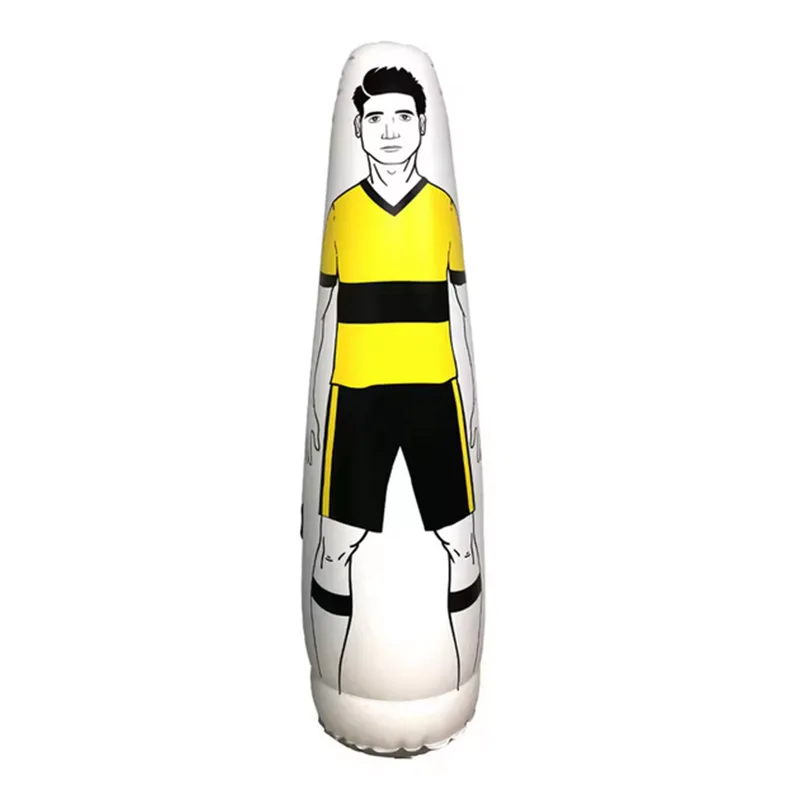
A Free Kick Mannequin with Metal Base is a specialized soccer training aid designed to recreate the visual obstacle of a defensive wall during set-piece practice. Compared with lightweight training markers, a mannequin with a metal base can provide a more realistic and stable training target for free kicks, crossing exercises, passing drills, and tactical routines. The right design should balance stability, durability, visibility, portability, and ease of setup. This guide explains the structure, applications, benefits, selection considerations, maintenance requirements, and purchasing factors that coaches, academies, schools, clubs, distributors, and sports-equipment buyers should understand before choosing this type of training equipment.

A Free Kick Mannequin with Metal Base is a soccer training device used to reproduce the visual presence of defenders during set-piece and technical training. Instead of asking players to repeatedly form a defensive wall, coaches can position mannequins at specific distances and angles to create repeatable training conditions.
The metal base is an important part of the structure. It helps keep the mannequin positioned on the training surface and provides a solid foundation when the equipment is exposed to repeated ball impact, outdoor use, or frequent repositioning.
Modern soccer training requires equipment that can be used repeatedly without making every drill complicated. A mannequin therefore needs to combine practical setup with sufficient stability and visibility. JINLANGTE Sports currently lists the Free Kick Mannequin with Metal Base among its football equipment products, alongside soccer mannequins and other site-training equipment.
Although designs vary between manufacturers, a free-kick mannequin normally consists of a visible mannequin or wall section and a supporting base. The combination determines how the product behaves during training.
| Component | Primary Function | Important Consideration |
|---|---|---|
| Mannequin Body | Simulates defenders | Visibility and suitable dimensions |
| Metal Base | Supports stability | Strength, weight and surface compatibility |
| Connection Structure | Links the mannequin and base | Secure assembly and repeated use |
| Surface Contact Area | Transfers load to the ground | Stability on different training surfaces |
Free-kick training is not simply about striking the ball hard. Players must understand how to control height, curve, pace, direction, and placement. A stationary mannequin provides a repeatable reference point that helps coaches create structured exercises.
For example, a coach can position several mannequins together to represent a defensive wall. The player then attempts to send the ball over, around, or between designated areas. Because the obstacle remains consistent, the coach can repeat the drill and compare changes in technique.
The biggest practical advantage is repeatability. Coaches do not have to depend on players maintaining exactly the same position for every repetition.
The base is often overlooked when buyers focus on the mannequin itself. In practice, however, base construction has a direct influence on how conveniently the equipment can be used.
A sufficiently robust metal base can help keep the mannequin in position during repeated training sessions.
A stable support structure makes it easier to recreate the same drill setup from session to session.
Metal components can be appropriate for training equipment that is assembled, moved and used frequently.
A structured base helps coaches build more organized training stations for academies, clubs and schools.
Stability should not simply mean maximum weight. A useful product needs an appropriate balance between stability and portability. An excessively heavy training aid may become difficult to transport, while a very lightweight design may be less suitable for certain outdoor drills.
The Free Kick Mannequin with Metal Base can support a broad range of soccer training environments. Its applications extend beyond a single free-kick exercise.
JINLANGTE describes its sports-equipment business as serving training institutions, fitness clubs, schools, public and private organizations, and individual or group customers. Its product range includes football goals, training equipment, soccer mannequins and other sports accessories.
Choosing a training mannequin should involve more than comparing appearance or unit price. Buyers should evaluate how the product will actually be used, transported, stored and maintained.
| Buying Factor | Questions to Ask |
|---|---|
| Base Construction | Is the base sufficiently stable for the intended training environment? |
| Dimensions | Does the mannequin provide a realistic visual obstacle? |
| Materials | Are the materials suitable for repeated indoor or outdoor use? |
| Portability | Can coaches move and store the product efficiently? |
| Customization | Can size, appearance, logo or packaging be adapted for specific requirements? |
| Supplier Capability | Can the manufacturer support consistent production and bulk orders? |
Soccer coaches have access to many types of training obstacles, and each serves a different purpose. The right choice depends on the drill rather than a single universal specification.
| Training Equipment | Typical Purpose | Main Characteristic |
|---|---|---|
| Free Kick Mannequin | Set pieces and defensive simulation | Human-shaped visual obstacle |
| Agility Cone | Footwork and movement | Small and highly portable |
| Agility Hurdle | Speed and jumping drills | Creates a physical movement barrier |
| Inflatable Mannequin | Defensive simulation | Lightweight and convenient to transport |
| Rebounder | Passing and ball reaction | Returns the ball for repeated practice |
A well-designed mannequin can be integrated into different training combinations rather than being limited to one exercise.
Place several mannequins at appropriate intervals to imitate a defensive wall. Players practice different striking techniques and attempt to place the ball into predetermined target areas.
Position mannequins inside or around the penalty area. Players deliver crosses while teammates work on timing, movement and finishing.
Use mannequins as defensive obstacles and ask players to identify passing lanes before receiving or releasing the ball.
Combine mannequins with cones, goals and target zones to reproduce a more complete attacking free-kick sequence.
Training equipment is exposed to repeated handling, ball impact, weather and transportation. Simple maintenance practices can reduce unnecessary wear.
These steps are especially relevant for clubs and training centers where equipment may be used several times each week.
For wholesale, distribution, academy procurement or customized orders, product specifications are only one part of the purchasing process. Buyers should also clarify production and service details before confirming an order.
For B2B buyers, supplier transparency can be just as important as the product itself. A manufacturer with experience across multiple categories can also help buyers build a broader training-equipment portfolio.
Shaoxing Jinlangte Sports Goods Co., Ltd. operates in sporting-goods manufacturing and offers football training products alongside equipment for basketball, baseball, volleyball, fitness and referee use. Public company information identifies its sporting-goods manufacturing activities, while JINLANGTE's official site presents its football equipment and site-training product categories.
Yes. Its primary purpose is to create a stable visual obstacle that can simulate defenders during free-kick and set-piece exercises. The exact suitability depends on the product's construction, dimensions and intended training surface.
A stable mannequin maintains a more consistent training position. This allows coaches to repeat drills without constantly correcting the obstacle after every use.
Yes. Coaches can incorporate mannequins into passing, crossing, attacking movement, defensive positioning and set-piece exercises.
Not necessarily. The appropriate base depends on the training environment. Buyers should balance stability, portability, storage requirements and the type of surface where the mannequin will be used.
Yes. They can be incorporated into age-appropriate training sessions, provided that coaches select suitable dimensions, establish safe distances and supervise drills appropriately.
Distributors should review product construction, packaging, customization capability, order quantities, production consistency, delivery arrangements and supplier communication before purchasing in bulk.
A Free Kick Mannequin with Metal Base is more than a simple training obstacle. When properly designed, it provides a repeatable visual reference for free kicks, passing, crossing, attacking movement and set-piece routines. The metal base plays an important role in supporting stability, while the mannequin structure determines how realistically the equipment can represent defensive pressure.
For coaches and training organizations, the most important considerations are practical: stable positioning, appropriate dimensions, durable materials, convenient handling and compatibility with the intended training environment. For distributors and professional buyers, additional factors such as customization, packaging, production capability and supplier communication become equally important.
As a manufacturer of sporting goods and football training equipment, Shaoxing Jinlangte Sports Goods Co., Ltd. provides a product range covering soccer mannequins, site training equipment and other sports-training products. Its official product portfolio identifies the Free Kick Mannequin with Metal Base as part of its football equipment offering.
Whether you are sourcing equipment for a football academy, professional club, school, training center or sports distribution business, the right mannequin can make repetitive technical drills easier to organize and reproduce. For product specifications, bulk purchasing, customization requirements or supplier cooperation, contact us to discuss your soccer training equipment needs with Shaoxing Jinlangte Sports Goods Co., Ltd.